





Very few movies feel truly timeless. The Apartment, for example, is a masterpiece, but it’s very much a product of its time. It’s still a wonderful story, anchored by two incredible performances, but the social customs of 1960 don’t translate to the modern world. But that’s not the case for all old movies.
Sometimes, when you go back and revisit a cinema classic from a bygone era, you’re surprised to find just how well it holds up. The satire of 50-year-old movies like Network and Dirty Harry feels hauntingly prescient in the current era of exploitative, oversaturated mass media and widespread corruption in American law enforcement. When you watch a movie like Jurassic Park at an anniversary screening, decades after its initial release, it feels like you’re watching a brand-new movie on its opening weekend. It feels that fresh and vibrant and awe-inspiring.
George P. Cosmatos’ 1993 western Tombstone falls into that category. Stylistically, it has the feel of the old-school Hollywood westerns that were getting made more than three decades before it. But when you go back and watch it today, you also can’t believe it was made more than three decades ago.
Tombstone Is An Old-School Western With A Modern Feel

Stylistically, Tombstone is a throwback to the classic Hollywood westerns of yesteryear. By the end of the Golden Age of Hollywood, the kind of old-school westerns popularized by John Ford and Howard Hawks had gone out of fashion, and been replaced by the gritty, bloody, subversive, satirical anti-westerns of Sam Peckinpah and Sergio Leone. This revisionist era reached its natural stopping point in 1992, when Clint Eastwood gave it a fitting farewell in Unforgiven.
Just one year later, Tombstone arrived as a refreshing throwback to the more traditional, fun-filled, action-packed, old-fashioned, good-versus-evil westerns of Ford and Hawks. But it doesn’t feel old-fashioned; it has a modern feel, looking at the social norms of the Old West through the lens of our modern value system, and the filmmaking and dialogue have a modern clip and a nice, brisk pace.
The Wyatt Earp Story Never Gets Old

Tombstone was not the first western movie to deal with the life of Wyatt Earp — not by a long shot — and it wasn’t the last, either. In fact, within just a few months of its release, a competing Wyatt Earp biopic (simply titled Wyatt Earp) would be released to a much less enthusiastic response. Earp was one of the quintessential real-life western figures who influenced the heroes and villains of the western genre, so it’s hardly surprising that Earp himself can be seen all over the genre’s classics.
Earp’s story has been told and retold across dozens of movies, and those myths never get old. Tombstone covers almost all of them, from the Gunfight at the O.K. Corral to the Earp Vendetta Ride (where he assembled a posse to seek revenge against the outlaws who ambushed his brothers). Tombstone pulls together all the different details and pieces of lore that previous movies had contributed to the legend of Wyatt Earp, and puts its own spin on them.
Val Kilmer Steals The Show As Doc Holliday

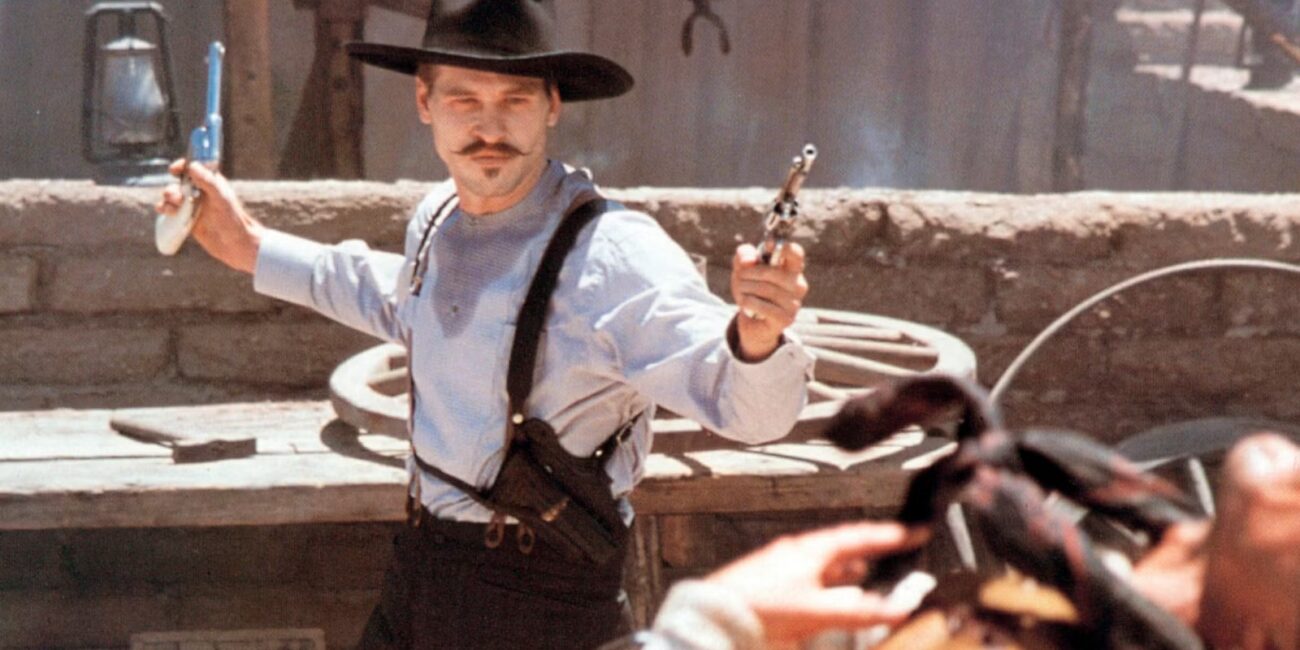
Val Kilmer doesn’t just steal the show in Tombstone; he is one of the go-to examples of a supporting player who stole the spotlight from the lead actor. And that’s not to take anything away from Kurt Russell, because he’s as charismatic and compelling as ever in the role of Earp. But Kilmer’s Doc Holliday runs away with the whole movie.
It might be the finest performance of Kilmer’s career. He really digs into the ugliness of addiction and the worsening delirium of this sickly, aging alcoholic. But through it all, he still has that unmistakable charm we saw in Heat and Top Gun and Batman Forever. This movie still holds up today mostly because it’s being held on the shoulders of Val Kilmer.
Tombstone Captures How Brutal The Old West Was

While Tombstone is a stylistic throwback to old-hat westerns from the Golden Age of Hollywood, it doesn’t whitewash its historical setting like those mythmaking classics. It doesn’t portray lawmen as unwaveringly good, like in High Noon, and it doesn’t portray lawbreakers to be plainly, unrepentantly, irredeemably evil. There’s nuance in the moral gray areas, and Tombstone digs into it.
Rather than sanitizing its depiction of the Old West, Tombstone captures just how brutal it was. From its very first scene, it doesn’t hold back.
Tombstone’s Script Doesn’t Waste A Word

A great movie needs a great script. You can make a terrible movie out of a great script (a great script is very easy to mess up in the execution), but you can’t make a great movie out of a terrible script. Tombstone is one of the rare cases where a great script was executed perfectly and turned into a great movie. Tombstone’s writer, Kevin Jarre, was originally lined up to direct the movie, but he was replaced by the much more experienced Cosmatos shortly into production. Jarre might not have had what it took to direct a movie of this scale, but he certainly had the chops to write one.
Jarre’s Tombstone script is about as close to perfect as a screenplay can get. It’s evenly paced, organically structured, and it’s full of quotable lines (mostly attributed to Holliday). No one will ever hear the phrase, “I’m your huckleberry,” and not think of Tombstone, and that’s the power of good writing.
Tombstone’s Ensemble Cast Is Full Of Standouts

Russell is a captivating lead as Earp, and Kilmer steals the show as Holliday, but they’re just the tip of the iceberg. Tombstone’s enormous ensemble cast is an embarrassment of riches, full of scene-stealing standouts. The casting team seemingly reached out to every legendary character actor in Hollywood, and all of those actors said yes, because the script was solid, and more importantly, because they all want to dress up as a cowboy and ride a horse and be in an old-timey western.
When you’re watching Tombstone, every five minutes, you find yourself pointing at the screen like Leonardo DiCaprio, because you recognize Locke from Lost or Quaritch from Avatar or the sex-crazed bachelor from Sideways. Sam Elliott and Bill Paxton play Earp’s brothers. Michael Biehn, usually seen as the action hero taking on Terminators and xenomorphs, plays against type as the villain. Powers Boothe, Michael Rooker, Billy Bob Thornton, and Billy Zane are all in this movie. Charlton Heston is in this movie. Robert Mitchum is the narrator.
When you rewatch an old favorite, you’re really watching it to revisit the characters and the performances you loved so much. Tombstone is jam-packed with them.
Tombstone’s Action Sequences Are Just As Thrilling Today

Westerns were the original action movies. All the tropes that we now associate with action movies — shootouts, showdowns, cops and robbers — began with the western. But by the time Tombstone came around, westerns had long evolved into action movies, and directors like Tony Scott and Michael Mann had come along to up the ante with more daring stunts and more dazzling spectacle.
Tombstone combines the old-school action stylings of the western genre, particularly good old-fashioned gun duels, and imbues them with the kind of modern action filmmaking tricks pioneered by the likes of Scott and Mann and Jackie Chan and John Woo. It’s a masterpiece of the western genre, but it’s also just a masterpiece of action cinema. Those practical stunts, and the clarity of that editing, will remain timelessly exhilarating long after the CGI smash-‘em-ups of Marvel movies have been forgotten about.

Tombstone

8/10
- Release Date
-
December 25, 1993
- Runtime
-
130 minutes
- Director
-
George P. Cosmatos
- Writers
-
Kevin Jarre