





World War II films have a natural challenge presented to them: The genre has produced so many timeless classics over the years that it can be tough to find an angle that actually feels unique. Pressure approaches this with a deliberately paced story that largely leaves the battlefield to highlight the people moving behind the scenes of the conflict.
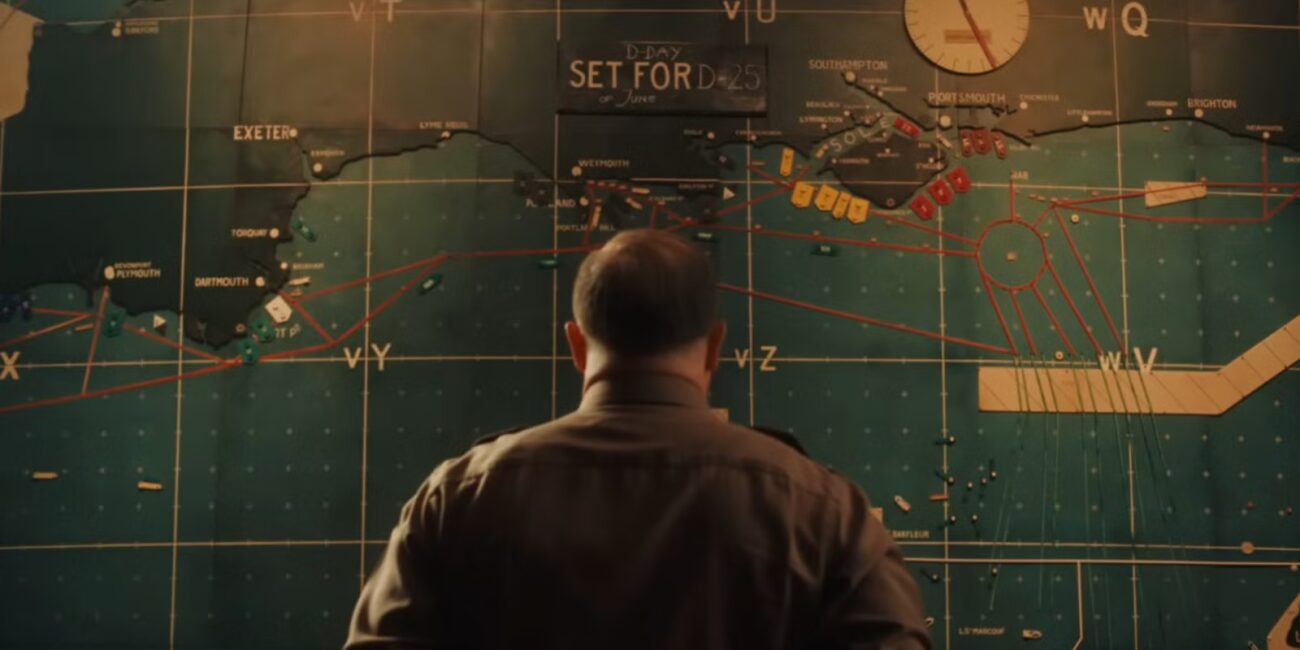
Set in the days right before D-Day, the Allied Invasion of Normandy, the movie largely focuses James Stagg and Dwight D. Eisenhower. Looking to confirm their plans for the attack, General Eisenhower recruits Stagg, a leading meteorologist with the Royal Air Force. However, tension grows when Stagg breaks from the accepted forecasts on D-Day and instead predicts far harsher conditions, leaving the commanders to debate whether to delay the invasion and risk it being exposed or push ahead amid potentially disastrous weather.
Based on the stage play of the same name by David Haig, Pressure is best when focused on those character-to-character moments where the stakes of their situation become overwhelming. As a result, the film is almost entirely rooted in the performances. Andrew Scott and Brendan Fraser do terrific work in the lead roles, and they’re magnetic enough to make a movie about debates over weather predictions riveting – even if the script and direction can’t quite match their tone. Pressure works best as a two-hander that occasionally surpasses the material, but it’s not necessarily a must-see for anyone who isn’t already interested in WW2 history.
Pressure’s Stars Are The Key To Making It Work

Pressure is almost entirely focused on Stagg and Eisenhower, especially as the former’s unyielding belief in the facts puts him up against the explosive general looking for the right call. Their dynamic, defined in only a few scenes together and largely away from one another, is the lifeblood of the movie.
Scott, who has always been a reliable supporting player in films like Wake Up Dead Man or in shows like Fleabag, does a great job of making a potentially monotonous character into someone whose resolve is shaken but never shattered. His harsher qualities, in direct contrast to characters like Kerry Condon’s Kay Summersby or Chris Messina’s Irving P. Krick, provide a lot of the film’s levity.
Similarly, Fraser does a great job at making Eisenhower come across as a man haunted by the potential for disaster (especially after a disastrous training mission), who is left with a short temper as a result. Both characters are able to showcase their resolve without ever losing their humanity, as little flashes of grief or fear creep in at key moments. The result is a dynamic that, at its best, proves that even just waiting to see if it rains can be effective drama.
Pressure Can’t Quite Match Its Best Elements

The problem with Pressure is that, outside those performances, there isn’t a lot going on. The script by Anthony Maras and David Haig gets all the technical elements right, but can’t really find a way to make the meteorology all that compelling on its own. The characters are largely one-note, with little in the way of clear arcs or progressions.
Andrew Scott and Brendan Fraser’s turns are its only distinguishing features.
Supporting characters crucial to the plot, such as Bernard Montgomery (Damian Lewis) and Con O’Neill’s Trafford Leigh-Mallory (Con O’Neill), get little in the way of depth beyond their roles contrasting Eisenhower in the war room. Everyone does good work with what they’ve been given, but the main characters lack the richness that can make historical figures really come alive in adaptations of history.
The editing is likewise fairly basic, although the sound team deserves some real credit for the way they’re able to play with noise, music, and dialogue to reinforce Stagg’s emotional state. The actual narrative builds to a third-act swerve that, while reflective of history, doesn’t land quite right, because the film hasn’t been able to properly emphasize why it’s such a big deal.
The best war movies are the ones that peel back the humanity of the real-life figures, reexamining historical events from a more humanist perspective. When it does that, Pressure sings. But the film’s explanation, tension, and resolution are often more basic history than intriguing introspection. All in all, it’s a competently made film that history buffs will appreciate, but Andrew Scott and Brendan Fraser’s turns are its only distinguishing features.
Pressure releases in theaters nationwide on Friday, May 29.