






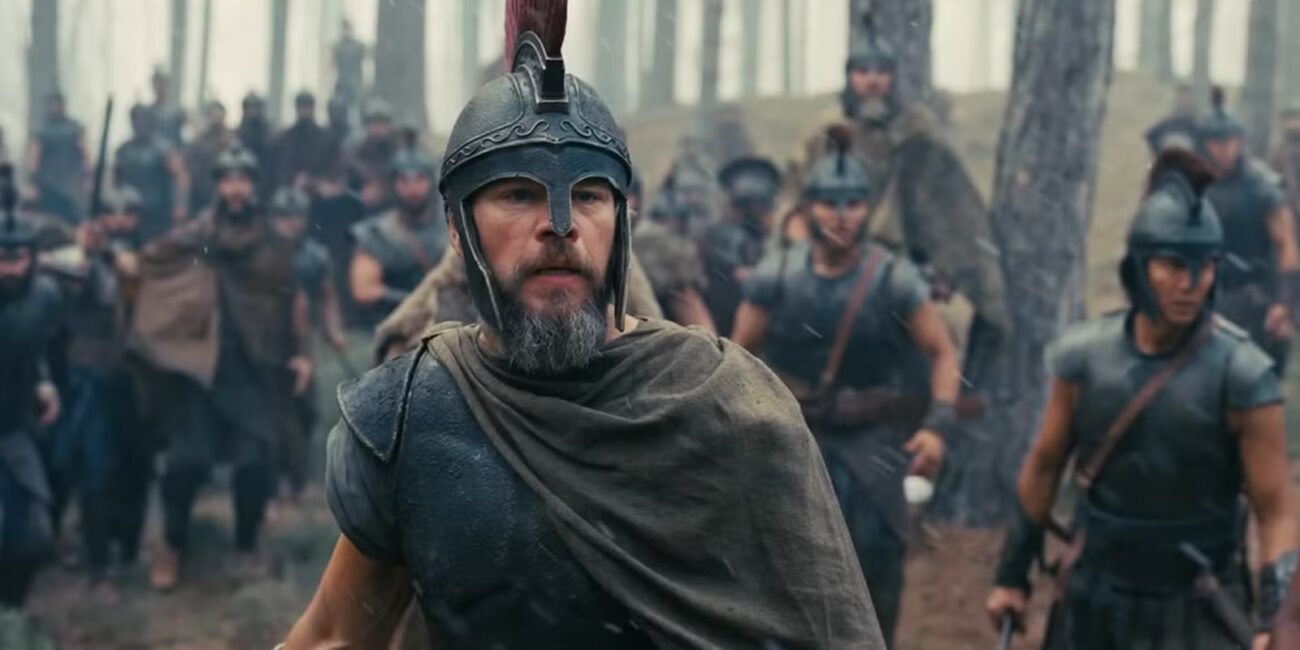
Christopher Nolan will soon bring an epic of ancient Greek Literature to the big screen when The Odyssey hits theaters this July. The Academy Award-winning filmmaker’s follow-up to the acclaimed Oppenheimer finds him tasked with adapting one of the oldest surviving works of literature into a feature film for modern audiences.
The Odyssey follows Odysseus (Matt Damon), the legendary king of Ithaca, who embarks on a long journey home after the ten-year-long Trojan War. As Odysseus faces all kinds of peril, including a cyclops and various Gods of Greek mythology, on his journey, his wife Penelope (Anne Hathaway) must contend with a collective of ill-intentioned suitors, led by Antinous (Robert Pattinson), who want to marry her. To maintain his family home, Odysseus’ son Telemachus (Tom Holland) embarks on a journey of his own as he tries to find his father and confirm whether he is truly dead.
The Odyssey is far from the first literary work that Christopher Nolan has translated to cinema. Oppenheimer was based on a Pulitzer Prize-winning biography by Kai Bird and Martin J. Sherwin and The Prestige was adapted from Christopher Priest’s 1995 novel, for instance. But The Odyssey represents a unique challenge for Nolan as he is bringing new life to a story translated repeatedly (and quite differently) over the centuries.
With so many translations and re-imaginings of Homer’s epic to draw on, there is one translation that stands above the rest that warrants a read if one wishes to dive into the source material Nolan draws upon in his new movie.
Emily Wilson’s The Odyssey Translation Is More Accessible Than Others

The first English language translation of The Odyssey dates back to the 17th century when George Chapman famously brought Homer’s 8th century BCE epic poem to Elizabethan England. Since then, over 60 English versions have been published, each differing in readability, theatricality, faithfulness to the original Greek text, and more.
While translations by the likes of Robert Fagles, Richmond Lattimore, and Robert Fitzgerald are widely regarded as among the go-to English language versions of The Odyssey, Emily Wilson’s groundbreaking translation should be the version people, especially beginners, seek out ahead of Nolan’s movie.
When it was published in 2017, Wilson’s translation became the first complete published translation of The Odyssey by a woman into the English language. Wilson’s representation of the poem’s female characters was lauded, but it is the accessibility of her text that makes this version so appealing.
Maintaining the original poem’s 12,110 lines, Wilson’s translation uses simple syntax in modern English to tell a story that is centuries old. She avoids the repetition of words and phrases found in other translations and employs iambic pentameter, the type of metric line that will be familiar to those who have read the works of William Shakespeare or John Milton.
Simply put, Wilson’s translation retains the themes and sweeping story of Homer’s epic poem but does so in an approachable manner by using plain, accessible language.
Wilson’s Translation Aligns With Nolan’s Filmmaking Style

In addition to the translation’s accessibility, Wilson’s work stands out among the variety of other English language translations of The Odyssey due to its rejection of overly elaborate and grand language, an attribute that appears to align closely with Nolan’s approach to the material.
Many translations of The Odyssey prioritize the poetic beauty of Homer’s story. The language used in these translations has a certain ornateness that, while imbuing the story with grand scope, undermines the urgency and grounded feel of the story.
This is where Wilson’s translation differs from most. In avoiding archaisms and telling the story of Odysseus in clean, simple language, Homer’s epic comes alive and strikes a brilliant balance between the drama and the story’s most fantastical elements.
Wilson’s writing aligns with how Nolan approaches filmmaking. Few directors craft movies as epic and grand as Nolan, but the filmmaker excels in giving his projects an immediacy and relatability. For instance, Oppenheimer is a sweeping, cinematic biopic that deftly balances the ticking time bomb of a story with rich and relatable emotion. This is what Wilson does in her translation of The Odyssey and what, based on promotional material, Nolan appears to do in his upcoming film.
