






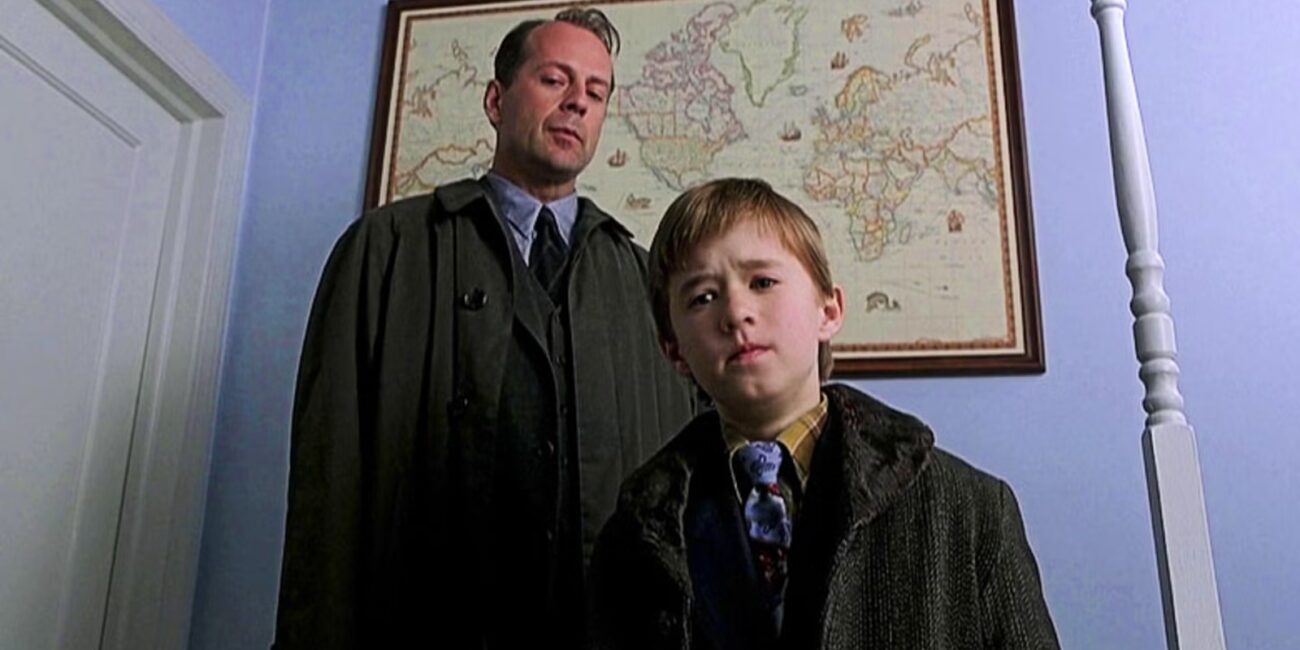
Grand twists in movies can be risky if they aren’t handled with care. Some infamous titles include shock reveals or wild endings so at odds with the rest of the production that they are remembered for all the wrong reasons. On the other hand, those twists can pay off in a remarkable way, enhancing an already brilliant story with a moment that feels earned and appropriate, as is the case with The Sixth Sense.
Few movies in any genre fit that description quite like The Sixth Sense. The title is an ambitious psychological thriller written and directed by M. Night Shyamalan. Bruce Willis stars as Malcolm Crowe, a child psychologist. One of his patients, Cole (Haley Joel Osment), makes the now-famous claim, “I see dead people.” That line is followed by another chilling omission where Cole explains he sees them all the time.
Malcolm is reluctant to believe Cole’s claims until he hears evidence that proves his patient is telling the truth. He also suggests Cole try to help those dead people instead of being afraid of them.
Despite the subtle clues in The Sixth Sense, the reveal that Malcolm is a ghost was jaw-dropping in 1999. In many ways, the reveal almost feels like a unique product of the 90s. Social media didn’t exist, and a spoiler of that magnitude stayed hidden for far longer than it would today.
The twist wasn’t just good; it was arguably the highlight of the movie, adding so much context to events that occurred before. It wasn’t just a perfect reveal. It was a twist with so much impact that few films have been able to emulate it.
Why The Sixth Sense’s “Dead People” Twist Is Still A Perfect Reveal

The revelation that Malcolm is actually a ghost is such a perfect reveal because it makes audiences question everything they have seen since the movie began. By the end of The Sixth Sense, audiences watching for the first time may have forgotten how traumatic the introduction was. Vincent (Donnie Wahlberg), one of Malcolm’s former patients, breaks into his home and ultimately shoots him.
We presume Malcolm survived the attack because the movie gives us no reason to assume otherwise. As much of the title focuses on his and Cole’s relationship, it’s easy to skim over some of the more unusual encounters in the movie.
The scene where Malcolm returns home at the end of The Sixth Sense is powerful in that his reaction isn’t theatrical, but emotional because it comes across as genuine acceptance of his situation as we catch another glimpse of the shooting. It’s a perfect moment because it feels earned. So many movie reveals fall flat because they don’t make sense. The twist in The Sixth Sense feels like part of the story the entire time; we just didn’t realize it, much like Malcolm himself.
The Sixth Sense Is Still Great Even When You Know The Twist

One of the greatest things about The Sixth Sense is that the twist doesn’t spoil future viewings. In fact, it makes a rewatch even more interesting as you can watch the entire movie with a fresh perspective. The twist hits so hard because every single scene is presented as if people don’t even know that Malcolm is there.
People seem distant and sometimes rude during the first watch, but those behaviors make complete sense during a future viewing. Shyamalan also seems to have ensured that audiences wouldn’t find any inconsistencies during a rewatch. For example, most viewers will quickly spot that Cole is the only person who converses with Malcolm during most of the movie.
The twist also presents other characters’ actions in a completely new light. Malcolm believes his wife Anna (Olivia Williams) is giving him the silent treatment, and it’s believable during your first watch. Her silence makes even more sense on a second viewing, since she couldn’t see or hear him.
There are also plenty of smaller details that make a rewatch special. Audiences will notice that no one besides Cole makes eye contact with Malcolm. The restaurant scene also hits so much harder when you realize that Anna didn’t abruptly leave in anger, as Malcolm was never there, and she never heard his apology for arriving late.

- Release Date
-
August 6, 1999
- Runtime
-
107 minutes
- Producers
-
Barry Mendel, Frank Marshall, Kathleen Kennedy