






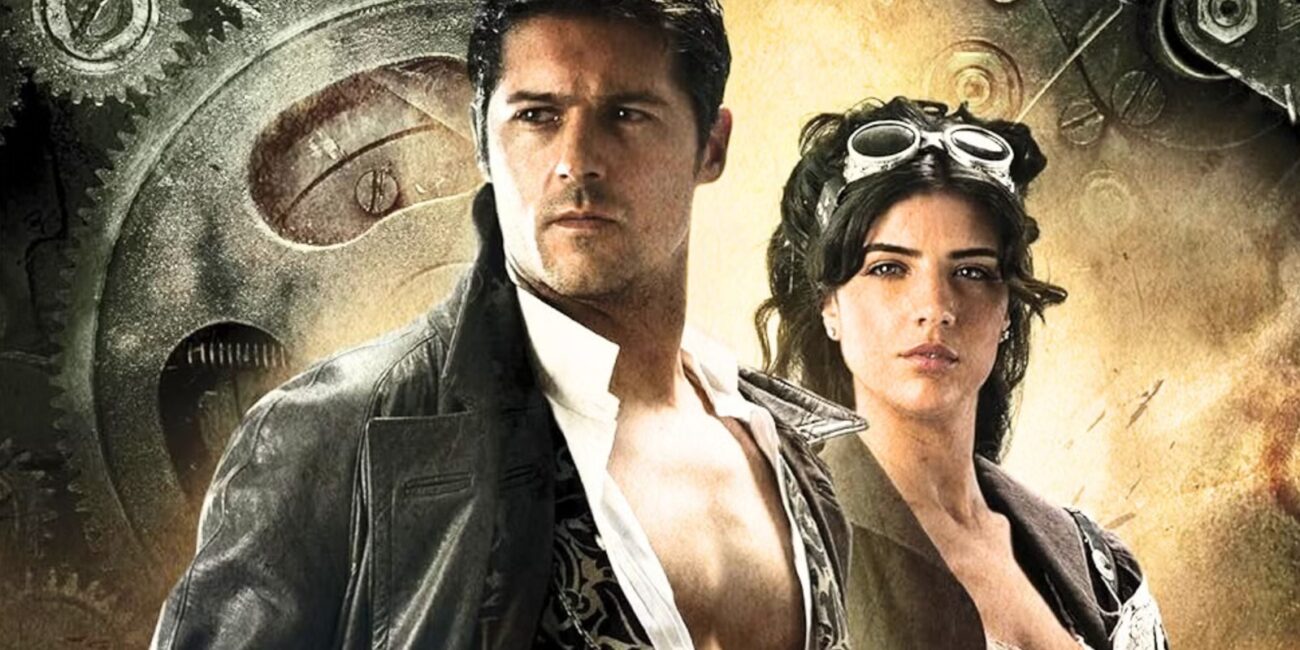
Few fantasy subgenres have exploded in popularity over the last few decades like steampunk. Wrapping up impossible machinery, industrial innovation, and imaginative fantasy in a Victorian aesthetic, steampunk has a unique identity that fans can’t get enough of. Whether powered by steam engines or intricate clockwork, the best steampunk books contain worlds unlike anything else in fantasy.
While there aren’t enough truly great steampunk movies or TV shows, it’s thriving on the page, and there are plenty of exceptional steampunk fantasy books out there that capture everything great about the genre in stories so riveting the pages practically turn themselves. From pirate-flavored airship adventures to romances in sprawling mechanical cities, the best steampunk novels showcase just how endlessly entertaining the fantasy subgenre can be.
The Tales Of The Ketty Jay Series By Chris Wooding (2009-2013)

Chris Wooding’s four-book The Tales Of The Ketty Jay series begins with 2009’s Retribution Falls. The novels follow Captain Darian Frey and his dysfunctional crew of sky pirates as they take their airship, the titular Ketty Jay, on a routine job that quickly spirals into a global conlfict. Drawing obvious inspiration from classic pirate adventure stories, the Ketty Jay series mixes high-flying action with witty dialogue and supernatural horror to create one of fantasy’s most entertaining steampunk worlds.
The world Captain Frey and his crew sail the Ketty Jay through is packed with airships, mechanical innovations, and daemon-powered technology, but Wooding never lets the setting overshadow the characters. This blend of swashbuckling action and emotional storytelling gives the series remarkable longevity, while its accessible writing makes it an ideal gateway into steampunk fantasy. Few books balance solid fantasy worldbuilding and genuine heart as effectively as The Tales Of The Ketty Jay, making it a defining example of what makes steampunk great.
The Leviathan Trilogy By Scott Westerfeld (2009-2011)

Starting with 2009’s Leviathan, Scott Westerfeld’s YA steampunk trilogy reimagines the First World War as a conflict between two radically different technologies. The Clankers (Austria-Hungary, Germany, and the Ottoman Empire) rely upon towering steam-powered walkers, massive mechanical weapons, and advanced engineering. Meanwhile, the Darwinists (Britain, France, and Russia) deploy genetically engineered living weapons. The central concept immediately distinguishes the Leviathan trilogy from virtually every other steampunk series, though its unique premise isn’t the only reason it’s one of the genre’s best.
Rather than relying exclusively on Victorian machinery, Westerfeld creates a fascinating clash between mechanical and biological science, resulting in some truly spectacular battle scenes. The coming-of-age stories of central characters Alek and Deryn complement the imaginative steampunk-meets-biopunk worldbuilding, with global conflict and teen romance woven together seamlessly. The Leviathan trilogy remains one of young adult fantasy’s finest achievements while offering some of the most creative alternate-history steampunk ever written.
The Clockwork Century Series By Cherie Priest (2009-2015)

Just like Scott Westerfield’s Leviathan trilogy reimagines WW1 with steampunk technology, Cherie Priest’s six-book Clockwork Century series, starting with 2009’s Boneshaker, takes place after an alternate American Civil War has transformed Seattle into a walled city filled with toxic gas, undead monsters, eccentric inventors, and extraordinary steam-powered machines. It’s one of the most distinctive settings in steampunk fiction, as Priest blends steampunk with horror and Western influences to create something refreshingly different.
Massive industrial technology and ingenious 19th-century contraptions create a survival horror atmosphere unlike almost anything else in steampunk fantasy. Each Clockwork Century novel expands the setting from different perspectives, gradually revealing the wider consequences of the world’s alternate history. The combination of historical inspiration and richly detailed machinery with some truly terrifying horror elements creates an unforgettable reading experience that proves steampunk can comfortably embrace multiple genres without losing its identity.
The Alchemy Of Stone By Ekaterina Sedia (2008)

Unlike many adventures that emphasize spectacle, Ekaterina Sedia’s 2008 novel The Alchemy Of Stone is an intimate character study wrapped inside a lavishly detailed steampunk city. The story follows Mattie, an intelligent automaton alchemist caught between political revolution and her own search for identity in a society built upon rigid hierarchies. The clockwork engineering and industrial landscape of The Alchemy Of Stone certainly deliver the visual appeal expected from steampunk, but its greatest strength lies in the philosophical questions it asks.
Themes of free will, class conflict, personhood, and social change give the novel unusual emotional depth. However, this doesn’t come at the cost of exploring The Alchemy Of Stone’s rich steampunk setting. Ekaterina Sedia’s almost lyrical prose further distinguishes the book, creating a tone that’s elegant and melancholic rather than action-driven. Readers looking for a more cerebral approach to steampunk fantasy will find The Alchemy Of Stone among the genre’s most rewarding standalone novels.
The Books Of Babel Series By Josiah Bancroft (2013-2021)

Author Josiah Bancroft’s four-volume The Books of Babel series begins with 2013’s Senlin Ascends. It’s here that readers are introduced to the colossal Tower of Babel, a mountain-sized structure where every city-sized level functions as its own bizarre society. Schoolteacher Thomas Senlin enters the tower searching for his missing wife before quickly becoming embroiled in its dangerous world. While this premise could work with many fantasy subgenres, the series’ elaborate machinery, airships, and Victorian-inspired aesthetics firmly place it among modern steampunk’s finest works.
Each “ringdom” of the tower in The Books Of Babel novels offers inventive new environments that continually reinvent readers’ expectations, ensuring the setting never becomes repetitive. Bancroft combines this literally layered worldbuilding with believable character growth, allowing the mysteries surrounding the tower to unfold gradually across the entire series at a pace that doesn’t overwhelm Thomas’s emotional journey. Few literary fantasy settings inspire as much curiosity, making The Books Of Babel one of the most imaginative steampunk book series published.
The Bas-Lag Novels By China Miéville (2000-2004)

China Miéville’s Bas-Lag trilogy consists of 2000’s Perdido Street Station, 2002’s The Scar, and 2004’s Iron Council. While each novel tells a separate story, all explore the astonishing world of Bas-Lag, where magic, grotesque biology, advanced machinery, and industrialization combine into one of steampunk’s richest settings. However, rather than embracing the traditional Victorian elegance associated with the genre, Miéville presents dirty cities, oppressive governments, bizarre races, and unsettling technologies that make for a solid weird fiction read just as much as a steampunk one.
Bas-Lag’s steam engines, scientific experimentation, magical engineering, and impossible machines seamlessly coexist, producing a world unlike any other in steampunk literature. Author China Miéville’s imagination seems almost limitless, constantly introducing unforgettable creatures and radical ideas without ever feeling random. Although they aren’t light reading, the Bas-Lag novels reward patient readers with extraordinary depth and remain one of the most influential steampunk fantasy series ever written.
The Difference Engine By William Gibson & Bruce Sterling (1990)

Legendary cyberpunk authors William Gibson and Bruce Sterling teamed up to swap cybernetics for clockwork in 1990’s The Difference Engine. This foundational steampunk novel imagines an alternate 19th century in which Charles Babbage successfully perfects his Analytical Engine, launching the computer age more than a century early. The result is a radically transformed Victorian Britain where technological progress radically reshapes global history. Although often considered one of the foundational works of steampunk, The Difference Engine stands out because it treats speculative technology with remarkable seriousness.
Rather than relying on fantasy adventure alone, Gibson and Sterling carefully explore how advanced mechanical computing arriving in the Industrial Revolution would alter everyday society. The dense political intrigue rewards attentive readers while showcasing how deeply alternate history can enrich steampunk storytelling. Countless later novels borrowed ideas from The Difference Engine, making it essential reading for anyone interested in understanding how modern steampunk evolved into the thriving genre it is today.
The Parasol Protectorate Series By Gail Carriger (2009-2012)

Steampunk and supernatural fantasy go hand-in-hand, but few combine the two with the charm of Gail Carriger’s The Parasol Protectorate. Kicking off with 2009’s Soulless, Carriger crafts a delightfully unconventional version of Victorian England populated by vampires, werewolves, ghosts, and ingenious mechanical inventions. At its center is Alexia Tarabotti, whose lack of a soul makes her immune to supernatural powers and places her at the heart of increasingly dangerous mysteries.
The Parasol Protectorate novels deftly balance romance, comedy, and steampunk without allowing any single element to dominate. Alexia’s wit and practicality make her an immensely entertaining protagonist, while the lighthearted tone distinguishes the series from some of the darker or more academic-leaning steampunk novels out there. Readers looking for fast-paced adventures with memorable characters and consistently clever dialogue will find The Parasol Protectorate among the best steampunk book series ever written.
The Iron Seas Series By Meljean Brook (2010-2014)

The Iron Seas series by Meljean Brook is a fantasy book with a predominantly romantic core, but it still presents one of the most intriguing steampunk settings ever written. 2010’s The Iron Duke, the first novel in the saga, thrusts readers into an alternate world transformed after humanity overthrows the genocidal Horde, a technologically advanced version of Genghis Khan’s Mongol Empire. Steam-powered industrialized warfare dominates a globe still recovering from generations of occupation and conflict, and Brook excels at weaving this expansive geopolitical worldbuilding into a rich backdrop for some truly steamy romances.
Every installment in the Iron Seas series explores different corners of the setting, gradually revealing new cultures and political tensions that make the world feel remarkably alive. The sophisticated blend of romance and military conflict ensures the books’ appeal extends well beyond steampunk fans. Combining consistently inventive technology with memorable characters and well-written romantic arcs, Brook’s Iron Seas delivers one of steampunk literature’s most fully realized worlds.
The Mortal Engines Quartet By Philip Reeve (2001-2006)

It’s impossible to discuss steampunk fantasy novels without diving into Phillip Reeve’s Mortal Engines quartet, which helped make the genre mainstream thanks to becoming so successful it spawned a blockbuster movie in 2018. 2001’s Mortal Engines, the first book in the saga, introduced one of fantasy’s greatest high-concept settings: gigantic mobile cities that literally hunt and consume smaller towns for resources. This philosophy of Municipal Darwinism immediately creates a world unlike anything else in steampunk fiction.
The enormous traction cities in the Mortal Engines novels represent steampunk imagination at its absolute best, combining impossible engineering with believable social, political, and economic systems. However, despite its spectacular setting, Philip Reeve never loses sight of compelling characters and surprisingly emotional storytelling, allowing the worldbuilding to enhance rather than dominate the narrative. Few steampunk fantasy series balance unforgettable ideas with a riveting character-driven plot as successfully as the Mortal Engines quartet, making it the definitive recommendation for anyone wanting to explore the genre.