






Very few filmmakers have been as wildly hit-and-miss as Sir Ridley Scott. Scott is responsible for an inordinate amount of the greatest films ever made — Alien, Blade Runner, Gladiator, The Martian — but he’s also responsible for more than his fair share of the absolute worst (A Good Year was not a good film). Thelma & Louise is one of the best movies I’ve ever seen, but The Counselor was so bad that I wish I’d never even watched it.
Scott has directed some movies that were really good, but fell just short of great, like The Last Duel or American Gangster. Some have been bad, but not quite terrible, like his generic actioner Body of Lies and his pointless Silence of the Lambs sequel Hannibal. Scott dabbles in a lot of different genres, and he gets it wrong just as often as he gets it right. Black Hawk Down is one of the most intense war movies ever made, but Exodus: Gods and Kings is one of the blandest, most forgettable Biblical epics.
Some of Scott’s movies are overrated — Legend is a cult classic, but its only redeeming quality is an underutilized Tim Curry — but some of them remain criminally underrated. Some of his best films have slipped under the radar, like Matchstick Men, or been unfairly lambasted by critics, like Alien: Covenant.
The Duellists

Scott’s first feature still holds up as one of his very best. The Duellists was promptly overshadowed by Scott’s next two films, Alien and Blade Runner, which were even more incredible. But The Duellists is a testament to the strength of traditional filmmaking: using sounds and images to tell a simple but effective story (taken from Joseph Conrad’s 1908 piece “The Duel”). Set in France during the Napoleonic Wars, The Duellists revolves around a 20-year feud between two rivals, a Bonapartist played by Harvey Keitel and a royalist played by Keith Carradine. Their duels reflect the wider political turmoil of early 19th-century France.
The Duellists was met with universal praise from critics, who lauded Scott’s direction, Frank Tidy’s cinematography, and the movie’s historical accuracy. The duels, choreographed by master swordsman William Hobbs, have been hailed as one of the most authentic on-screen depictions of swordplay.
Black Rain

Sir Ridley hasn’t directed many straightforward action movies. Scott has directed plenty of incredible action sequences, but they’re usually in the context of an entirely different genre, like a sci-fi noir or a swords-and-sandals epic. When he does make a typical action movie, like Body of Lies, it tends to be one of his blander, more impersonal movies. Ridley’s brother Tony Scott was a master of this kind of action filmmaking, and the closest Ridley came to recapturing his brother’s magic was 1989’s Black Rain.
Black Rain is a very traditional, very conventional action thriller, starring Michael Douglas as a New York cop who escorts a powerful yakuza figure to Japan and loses him in the criminal underworld. But Scott’s direction is so sharp, and the visuals are so slick, and the pacing is so agreeable, that it stands proudly as a very, very good traditional, conventional action thriller.
Alien: Covenant

Both of Scott’s Alien prequels are underrated, but Alien: Covenant remains the most underrated. Scott learned from all the mistakes of Prometheus, and made Covenant as a more traditional haunted-house-in-space Alien movie. But, while Prometheus has been reappraised as a flawed masterpiece, Covenant is still an underappreciated gem.
Alien: Covenant is a haunting two-hander between two androids played by Michael Fassbender. The benevolent android, Walter, encounters the sadistic android, David, and the ensuing battle of wits is almost Shakespearean in its thematic, philosophical grandeur. But it’s not just an exercise in morality; it also has some of the most fiercely effective jump scares in the Alien saga, like the blood-drenched xenomorph attack in the shower (a sort of sci-fi Psycho). It also has some of the gnarliest body horror in the franchise, with airborne spores that drift into your ear and erode your brain.
After two hours of terror, Alien: Covenant culminates in a chilling twist ending. Just when our heroes have vanquished the xenomorph, and their good friend Walter is putting them to sleep in cryo chambers, they come to the horrifying realization that Walter is really David. The evil android has usurped the good one, and now, there’s nothing stopping him from carrying out his nefarious experiments.
Alien: Covenant might not quite reach the heights of Alien or Aliens, or even Alien: Romulus, but it’s not as bad as it’s made out to be. It’s a solid sci-fi horror movie, directed by the guy who practically invented the subgenre.
House Of Gucci

Scott had been developing House of Gucci for a while before he had a script he was happy with. He wanted to turn the story of Patrizia Reggiani’s attempted hit on her ex-husband Maurizio Gucci into a movie for years, but all the writers he brought in adapted it as a campy soap opera. Eventually, he had a script he was happy with, written by Becky Johnston and Roberto Bentivegna, that took the story seriously.
But honestly, the movie works best when it leans into the camp. It should’ve had a tongue-in-cheek satirical tone like The Secret Agent, rather than playing it totally straight and taking it super seriously. House of Gucci shines in those moments, and it shines whenever Lady Gaga is on-screen. It’s not a great movie, but it’s much, much better than its reputation would suggest.
Kingdom Of Heaven (Director’s Cut)

The theatrical version of Kingdom of Heaven has been rightly panned as one of Scott’s worst movies. It wanted to recapture the epic thrills of Gladiator, but Orlando Bloom just didn’t have the chops to carry a movie on his shoulders like Russell Crowe. The concept of using the Third Crusade to explore modern religious conflicts was a solid foundation, but the script struggles to pick a lane and settle into a narrative groove. The Crusades were a thrilling backdrop for a big religious epic, and the film is beautifully shot with some stunning battle sequences, but the theatrical cut excised a lot of important context that the director’s cut would reinstate.
Not every movie needs a director’s cut, but Kingdom of Heaven — much like Blade Runner — desperately needed an alternative version to restore Scott’s original vision after the studio messed it all up. The theatrical cut of Kingdom of Heaven is one of Scott’s worst films, but the director’s cut is one of his best.
Matchstick Men

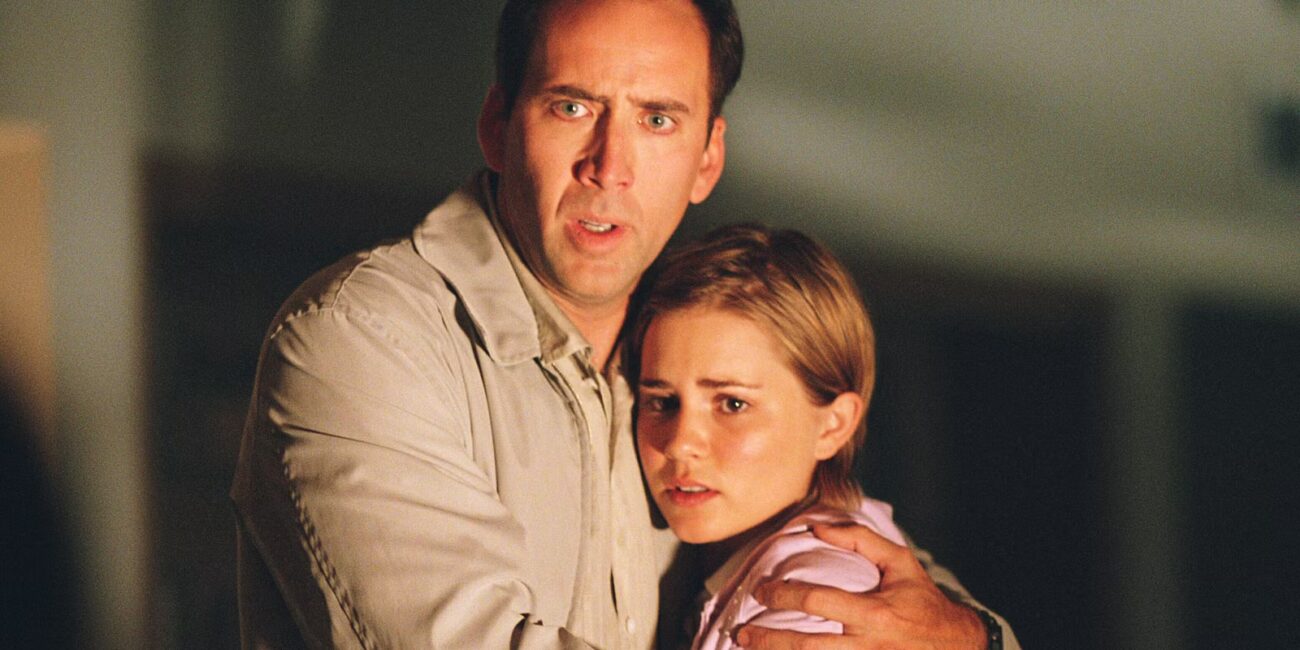
Matchstick Men feels more like a Coen brothers movie than a Ridley Scott movie. It’s a quirky crime caper along the lines of Fargo or Burn After Reading, with a delightfully dark sense of humor and a bleak sense of irony. Ostensibly, Matchstick Men is a movie about a con artist whose life is thrown into a tailspin when his estranged daughter shows up at his doorstep on the eve of his biggest con yet. But that’s just the jumping-off point; what follows is a series of increasingly shocking and unpredictable twists.
Nicolas Cage gives one of his best performances in the lead role; he’s in the wonderfully mopey, low-key register we saw in Adaptation and Dream Scenario. Sam Rockwell damn-near steals the show as Cage’s partner-in-crime, an early prototype of Rockwell’s zany, unpredictable performances in Martin McDonagh movies.