




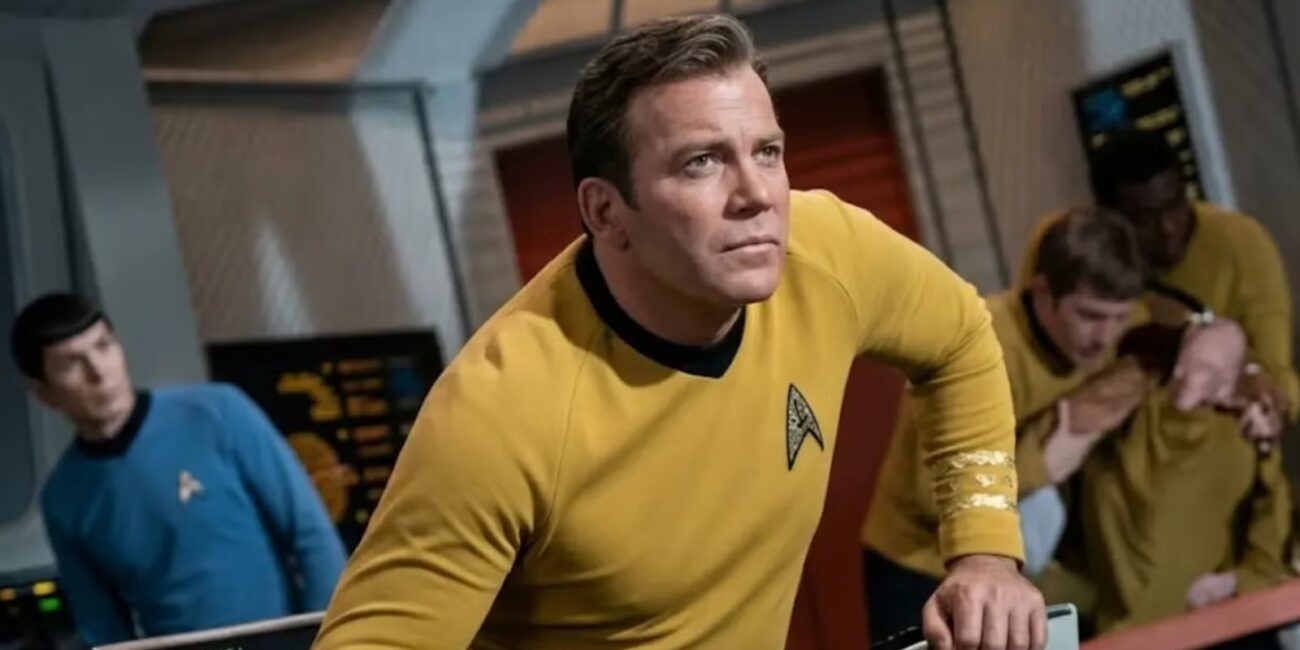
While fans may argue over which Star Trek series is the best or which captain deserves the most respect, the one thing everyone agrees with is that Captain Kirk is, undoubtedly, the blueprint all others are drawn from. James Tiberius Kirk, originally played by William Shatner, set the standard of what viewers should expect from Star Trek, mixing science fiction intellect with more than a dash of Old West determinism to bring to life one of the greatest characters to ever appear on TV and in movies.
And, like any good fictional figure, the lore surrounding Captain Kirk has only grown over time. His many exploits are not only famous to fans around the planet, but to the future generations of captains, lieutenants, and ensings that make up the Starfleet and the United Federation of Planets. Across shows, movies, comics, and books, Captain Kirk and his crew have faced dangers that no other team would dare imagine and, somehow, Kirk has always been able to pull off the impossible. Or, as his good friend Bones once pointed out, he turns death into a fighting chance to live.
Trying to examine every amazing feat Captain Kirk has pulled off would be a mission even he would struggle to complete. But some of the good Captain’s accomplishments are impossible to forget. These are the moments where Kirk truly proved himself, showing the galaxy why, no matter who came before and who comes after, there’s only one James T. Kirk.
5
Captain Kirk Is The Only Person Who Ever Beat The Kobayashi Maru
The most famous test every Starfleet cadet must go through is the Kobayashi Maru. The training exercise puts the cadet into the captain’s chair and presents them with a difficult scenario: a civilian ship — the Kobayashi Maru — has been damaged and is adrift in neutral territory between Federation and Klingon space. The cadet must decide whether to risk the life of their crew to save the civilians, or leave the civilians to die. If the cadet chooses to help the Kobayashi Maru, they find themselves caught in a Klingon trap that destroys their ship.
The point of the exercise is to teach Starfleet cadets that, no matter how skilled or intelligent they are, they will one day find themselves in a situation where they can not win. That, in life, there are always no-win scenarios. But, to James Kirk, that very concept is offensive. So, while a cadet himself, Kirk proved that he could beat the no-win scenario, becoming the only cadet to ever save the Kobayashi Maru without losing his ship.
Of course, he did it by cheating, but it showed that, long before he took control of the Enterprise, James Kirk was going to be a figure of great historical note. Because he did something that, as he himself put it, “had the virtue of never having been tried,” James Kirk was awarded a commendation for “original thinking.”

While Starfleet gets into plenty of battles with enemies like the Klingons, the Romulans, the Dominion, and the Borg, the actual purpose of the organization is exploration, as clearly stated in the opening of Star Trek and Star Trek: The Next Generation. Seeking out new worlds and finding new life and new civilizations is the primary mission of just about every captain, and certainly the primary mission for the captain of the Enterprise.
And, when it comes to making first contact with new lifeforms, no captain was better at it than James Kirk. While there’s no defifinitve count of how many civilizations Kirk was the first to meet, it is clearly an impressive number. In the Star Trek: Voyager Season 7 episode “Friendship One,” it is revealed that Captain Janeway, being some 30 thousand lightyears away from any other Federation ship, had made the most first contacts of any captain since Kirk, suggesting that Kirk was still number one of the leaderboard.
3
Captain Kirk Ensured The Khitomer Accords Were Signed

As seen in Star Trek VI: The Undiscovered Country, The United Federation of Planets and the Klingon Empire were at odds well before Captain Kirk was born, but things came to a head during the Federation-Klingon War of 2256. After that, the two entities were each other’s greatest foe, leading to decades of tensions and, on more than one occasion, some serious fighting. The Second Federation-Klingon War, taking place some 20 years later, didn’t calm things down any, but when Praxis, the moon of the Klingon homeworld Qo’noS, exploded, the Federation offered to help their enemy. Another group, wishing to keep the Klingons out of the Federation, attempted to destroy any hope for peace by making the Enterprise fire on the Klingon ship and assassinating Klingon Chancellor Gorkon.
Being the captain of the Enterprise, Kirk was quickly accused of being behind the plot and, unable to prove his innocence, is sentenced to the prison asteroid Rura Penthe. And, for added measure, Bones, who tried but failed to save the Chancellor’s life, is forced to join him. In time, thanks to the investigative work of the crew of the Enterprise, it becomes clear that Kirk did not order the assassination, and, even more, that another attempt to halt the peace process will happen on the Klingon planet Khitomer, where the treaty is to be signed.
Luckily, Kirk and Bones are able to escape Rura Penthe, get back onto the Enterprise, and arrive at Khitomer in time to stop the second attempt. Because of Kirk’s ingenuity, a peace between the Federation and the Klingon Empire was formed.
2
Kirk Saved The Earth… A Lot

Whenever Earth needed saving, Starfleet knew there was just one man they could count on: James T. Kirk. Sometimes, he even did it without being asked. In the Star Trek: Original Series episode “Assignment: Earth,” Kirk and the crew of the Enterprise find themselves in the year 1968 and helped an alien being called Gary Seven — who totally isn’t a Doctor Who knock-off — stop a nuclear warhead from going off and causing World War III to being decades too soon. In Star Trek: The Motion Picture, Kirk, now an Admiral, takes control of the Enterprise and flies out to stop V’Ger, which itself was the remnants of the Voyager 6 probe that combined with an alien craft to become an object of immense power that destroyed anything that wasn’t “the creator,”, from destroying Earth.
As it turns out, in the future of Star Trek, humpback whales will be extinct. This became a serious problem when an alien probe sending out a whale song was destroying Earth and the only way to stop it would be to have whales respond. Like any good hero, Captain Kirk, flying a Klingon Bird of Prey after having blown up the Enterprise in his last adventure to bring his best friend back to life (which, itself, is a heck of an accomplishment), was the only person who could save humanity’s homeworld. And that’s exactly what he did. Kirk and his small crew pulled out an old trick and flew as fast as they could around the sun, using the star’s gravitational pull to slingshot them back in time to 1984 to pick up a few humpbacks and bring them to the 23rd Century to tell the probe to calm down.
1
Captain Kirk Never Met A “God” He Couldn’t Beat
Exploring the galaxy means that Starfleet crews are sure to run into alien beings that are so powerful they seem like gods to lesser evolved species. These beings show up pretty often, and, like Q, often claim to be actual gods. But Captain Kirk wasn’t the kind of man who would put up with that kind of malarkey and had no problem taking these supposed “gods” down a peg or two. There were the beings on Pollux IV who claimed to be the Greek gods of old. To show them what he thought of their demands to be worshiped, Kirk destroyed the Temple of Apollo, taking away their power.
Then there was Trelane, an omnipotent being who was obsessed with 18th-century Earth and, as would later be discovered, was part of the Q Continuum. While the more famous Q loved to show up and mess with Captain Picard, Kirk gave Trelane such a scolding that he never dared bother the good captain again. The god of Sha Ka Ree, sitting at the center of the galaxy, was believable enough that Spock’s brother fell for it, but Kirk quickly realized the whole thing was a scam, unraveling the sherade with one simple question: “What does God need with a starship?”
A man of equality above all else, Kirk had no time for beings who claimed to be superior to others, and seemed to love little more than to teach them a quick lesson with his own intellect or, if needed, the power of his fists (and, in the case of Apollo, the power of the Enterprise’s phasers).
- TV Show(s)
-
Star Trek: The Original Series, Star Trek: The Animated Series, Star Trek: The Next Generation, Star Trek: Deep Space Nine, Star Trek: Voyager, Star Trek: Enterprise, Star Trek: Discovery, Star Trek: Short Treks, Star Trek: Picard, Star Trek Lower Decks, Star Trek: Prodigy, Star Trek: Strange New Worlds, Star Trek: Starfleet Academy
- Cast
-
William Shatner, Leonard Nimoy, George Takei, Nichelle Nichols, Deforest Kelley, James Doohan, Walter Koenig, Jonathan Frakes, Patrick Stewart, Michael Dorn, Marina Sirtis, Gates McFadden, Brent Spiner, LeVar Burton, Wil Wheaton, Avery Brooks, Nana Visitor, Rene Auberjonois, Alexander Siddig, Cirroc Lofton, Armin Shimerman, Colm Meaney, Terry Farrell, Kate Mulgrew, Robert Beltran, Roxann Dawson, Jeri Ryan, Robert Duncan McNeill, Robert Picardo, Ethan Phillips, Garrett Wang, Jolene Blalock, Connor Trinneer, Dominic Keating, Scott Bakula, Linda Park, John Billingsley, Anthony Montgomery, Chris Pine, Zachary Quinto, Simon Pegg, Zoe Saldana, Karl Urban, John Cho, Chris Hemsworth, Benedict Cumberbatch, Anton Yelchin, Idris Elba, Sonequa Martin-Green, Mary Wiseman, Doug Jones, Anthony Rapp, Wilson Cruz, Oyin Oladejo, Emily Coutts, Jess Bush, Christina Chong, Anson Mount, Ethan Peck, Rebecca Romijn, Michelle Yeoh
- Created by
-
Gene Roddenberry